
CBD Education, Vaping Awareness & Industry Insights
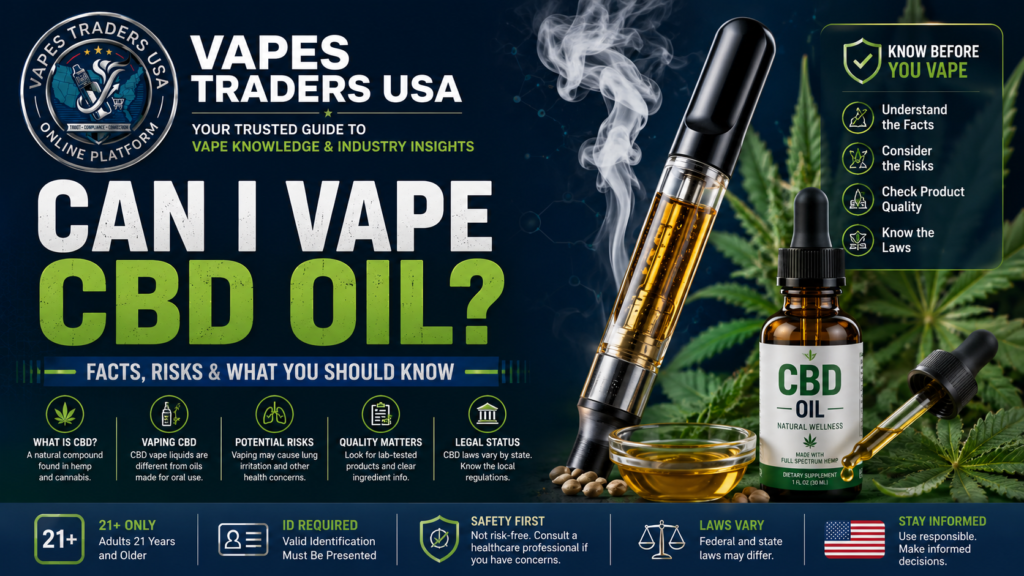
CBD has become a widely discussed cannabis-derived compound, appearing in products such as oils, capsules, creams, and specially formulated inhalable liquids. As interest grows, one question many people ask is: Can I vape CBD oil?
The short answer is that not every CBD oil is suitable for vaping. A CBD oil designed to be swallowed or used under the tongue is different from a liquid specifically formulated for inhalation. More importantly, vaping CBD is not risk-free, and scientists are still studying its potential effects on the lungs and overall health.In this guide, we explain the difference between CBD oils and vape liquids, discuss important safety concerns, and explore what consumers should understand before making decisions about CBD products.
What Is CBD Oil?
CBD stands for cannabidiol, a naturally occurring compound found in the cannabis plant. Unlike THC, CBD does not typically produce the intoxicating effects commonly associated with marijuana.
CBD products are available in several forms, including:
- CBD tinctures: Liquid products generally intended for oral use or placement under the tongue.
- CBD capsules: Products designed to be swallowed.
- CBD topicals: Creams, lotions, and balms intended for application to the skin.
- CBD vape liquids: Products specifically formulated and labeled for inhalation.
Although these products may contain the same compound, their ingredients, intended uses, and methods of delivery can be very different.
Can You Vape CBD Oil?
You should not assume that ordinary CBD oil can be used in a vape device.Many CBD tinctures contain carrier oils or other ingredients intended for oral use. These formulations are not automatically suitable for inhalation. Inhaling substances that were not designed for the lungs can create health risks.Some products are specifically marketed as CBD vape liquids. However, a product being labeled for vaping does not establish that it is safe. The long-term effects of inhaling CBD aerosols and their additional ingredients are not fully understood.
Important distinction: CBD oil intended to be swallowed is not interchangeable with a CBD liquid formulated for vaping. Do not put ordinary CBD tinctures, cooking oils, essential oils, or other non-vape liquids into an electronic cigarette or vaporizer.
CBD Oil vs. CBD Vape Liquid: What Is the Difference?
The main difference is the intended method of use and the formulation.
| Feature | CBD Oil / Tincture | CBD Vape Liquid |
|---|---|---|
| Intended use | Usually oral or under the tongue | Marketed for inhalation |
| Formulation | May contain oils and oral-use ingredients | Formulated for a vaporizing device |
| Delivery method | Through the digestive system or oral tissues | Through inhalation |
| Device required | Usually no | Requires compatible equipment |
| Main consideration | Oral-use safety and interactions | Additional inhalation and lung-related concerns |
Always read the product label and manufacturer information. A label that simply says “CBD oil” does not mean the product is suitable for vaping.
What Are the Potential Risks of Vaping CBD?
CBD is sometimes presented online as a natural or wellness-focused ingredient. However, natural origin does not automatically mean a substance is harmless.
There are several important considerations.
Possible Lung Irritation and Respiratory Effects
Vaping creates an aerosol that is inhaled into the respiratory system. The effects of inhaling CBD-containing aerosols are still being studied.A research study published in the European Respiratory Journal examined the pulmonary effects of CBD vaping in experimental models and reported inflammatory and lung-related changes. These findings do not establish the exact risks for every human user, but they reinforce the need for caution.
Unknown Ingredients and Contamination
CBD products can vary considerably in quality. Some may contain ingredients that are not clearly identified on the label.
Potential concerns include:
- Incorrect CBD concentration.
- Undeclared THC.
- Pesticide residues.
- Heavy metals.
- Microbial contamination.
- Ingredients or additives not suitable for inhalation.
A product’s appearance, packaging, or marketing claims cannot prove its purity or safety.
Possible Medication Interactions
CBD can interact with certain medications and may affect how the body processes them.The FDA has also identified potential concerns involving liver injury and other adverse effects associated with CBD. Anyone taking prescription medicines or managing a medical condition should speak with a qualified healthcare professional before using CBD.
Accidental THC Exposure
CBD and THC are different compounds, but some cannabis-derived products may contain both.THC can cause intoxicating effects and impair attention, memory, judgment, and coordination. A product labeled as CBD should not automatically be assumed to be THC-free.
Is CBD Vaping Safe?
There is not enough reliable scientific evidence to conclude that vaping CBD is safe, particularly over the long term.The safety of an inhaled product depends on more than its CBD content. Its other ingredients, manufacturing quality, possible contaminants, device characteristics, and exposure levels also matter.The CDC explains that CBD products are not risk-free and that the effects of different methods of CBD use are still being studied.It is also important not to confuse the safety of swallowing an ingredient with the safety of inhaling it. A substance that may be suitable for oral use is not necessarily suitable for the lungs.
What Should You Check on a CBD Product Label?
If you are researching CBD products, understanding the label is important. Product information can help identify what a product claims to contain, although a label alone cannot establish safety.
Consider checking the following information:
CBD and THC Content
Look for clearly stated CBD content and information about whether THC is present. Do not rely only on phrases such as “pure CBD” or “THC-free” without supporting documentation.
Third-Party Laboratory Testing
A Certificate of Analysis (COA) from an independent laboratory may provide information about cannabinoid content and certain contaminants.
Check whether the report:
- Matches the product and batch number.
- Identifies CBD and THC concentrations.
- Includes relevant contaminant testing.
- Comes from an identifiable laboratory.
A COA can provide useful product information, but it does not prove that inhalation is safe.
Intended Use
Check whether the manufacturer identifies the product as an oral tincture, topical product, capsule, or inhalable liquid.Never assume that a product is suitable for a vape device simply because it is liquid.
Manufacturer Information
Look for identifiable manufacturer details, ingredient information, batch identification, and clear product labeling. Be cautious about products making unsupported medical claims.
Is CBD Legal in the United States?
CBD laws in the United States can be complicated. Federal and state rules may differ, and the legal status of a product can depend on its source, THC content, formulation, and intended use.The 2018 Farm Bill removed qualifying hemp from the federal Controlled Substances Act definition of marijuana, using a delta-9 THC threshold of no more than 0.3% on a dry-weight basis. However, this does not mean every CBD product is automatically legal, FDA-approved, or permitted for every use.The FDA has approved a prescription CBD medicine for specific seizure-related conditions. That approval should not be confused with approval of general retail CBD oils or CBD vape products.Consumers should check current federal, state, and local requirements before making decisions about CBD products.
Frequently Asked Questions
Can I put regular CBD oil in a vape?
No. Ordinary CBD tinctures and oral oils should not be put into a vape device. They may contain carrier oils or other ingredients not intended for inhalation.
Is CBD vape liquid the same as CBD oil?
No. CBD vape liquids are marketed for inhalation, while many CBD oils are intended for oral use. Their formulations and intended delivery methods are different.
Does vaping CBD make you high?
CBD itself is not generally intoxicating in the way THC is. However, some products labeled as CBD may contain THC or other cannabinoids, so product composition matters.
Can CBD vaping affect your lungs?
It may. Research on the respiratory effects of inhaled CBD is still developing, and experimental findings have raised concerns about inflammation and lung effects. Long-term human safety has not been established.
Is CBD vape oil FDA-approved?
The FDA has not approved general retail CBD vape products as safe or effective treatments. Its approval of a prescription CBD medicine applies to specific medical uses, not ordinary CBD vape liquids.
Can CBD interact with prescription medication?
Yes. CBD may affect how certain medications work and can cause adverse effects. Speak with a healthcare professional before using CBD if you take medication.
Is CBD oil the same as THC oil?
No. CBD and THC are different cannabinoids. CBD is not typically intoxicating, while THC can produce intoxicating effects. Some products may contain both compounds.
Final Thoughts: Understand CBD Before Making a Decision
So, can you vape CBD oil? The important answer is that ordinary CBD oil should not be used in a vape device, and even products specifically marketed for CBD vaping are not proven to be risk-free.Understanding the difference between oral CBD oils and inhalable products, checking ingredient information, recognizing potential medication interactions, and reviewing applicable laws can help readers make more informed decisions.
At Vapes Traders, our goal is to make business and industry information easier to explore. We encourage readers to approach CBD and vaping-related topics with care, rely on credible health information, and avoid assuming that a product is safe simply because it is marketed as natural.
Disclaimer: This article is for general educational and informational purposes only. It is not medical or legal advice and does not recommend starting CBD use or vaping. Consult a qualified healthcare professional about health concerns, medications, or CBD use. Product laws and regulations vary by location.