
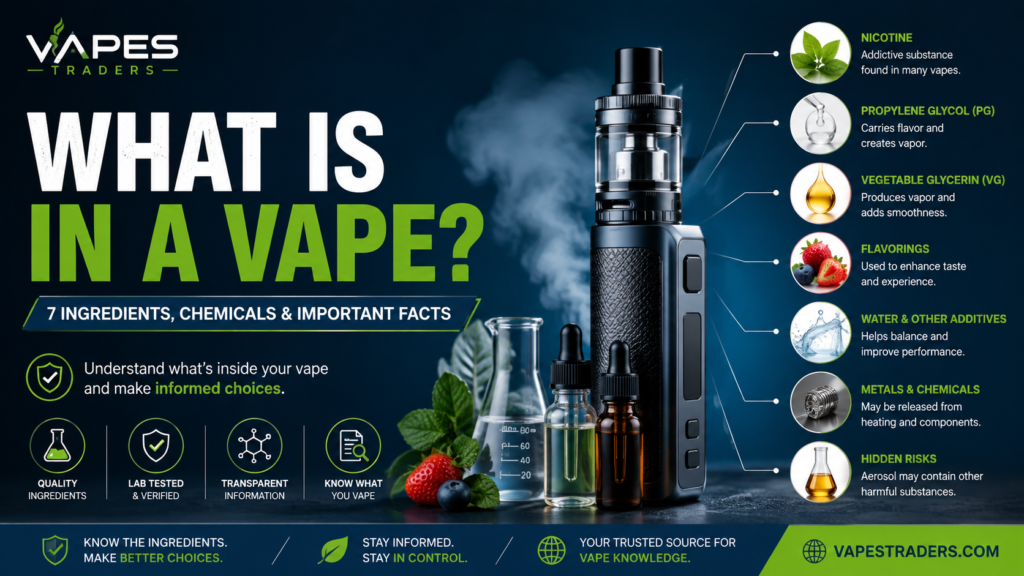

Have you ever wondered what is actually inside a vape? Many people recognize the different shapes and designs of electronic cigarettes, but fewer understand what goes into the liquid, how the device works, or what substances may enter the lungs when someone uses one.The answer is more complicated than simply nicotine and flavoring.Most traditional nicotine vapes contain an electronic heating system and a liquid commonly made with propylene glycol, vegetable glycerin, flavorings, and sometimes nicotine. When the device heats this liquid, it produces an aerosol that users inhale.However, the exact ingredients can vary between products, and the aerosol may contain additional substances formed during heating or released from device components.
In this guide, Vapes Traders explains what is in a vape, what its main ingredients do, which chemicals may be present, and what consumers should understand about potential health risks.
What Is Inside a Vape?
A typical electronic cigarette contains two main elements: the device itself and the e-liquid.The device contains electronic components that generate heat, while the e-liquid contains the substances that are heated.
Most vaping devices include:
- Battery: Supplies electrical power.
- Heating element or coil: Heats the liquid.
- Tank, cartridge, or pod: Holds the e-liquid.
- Wick: Helps deliver liquid to the heating element in many designs.
- Mouthpiece: The part through which the aerosol is inhaled.
- Electronic controls or sensors: Regulate or activate the device.
Not every vape contains exactly the same components. Disposable devices, refillable pod systems, and larger tank devices can have different designs.
Nicotine
Nicotine is one of the most commonly discussed ingredients in vaping products.It is an addictive chemical naturally found in tobacco plants. Many e-liquids contain nicotine, although some products are marketed as nicotine-free.
Two common forms are:
Freebase nicotine: A form of nicotine commonly used in traditional e-liquids.
Nicotine salts: A formulation that can make higher nicotine concentrations feel less harsh during inhalation.Nicotine can increase heart rate and blood pressure and cause dependence. It is particularly concerning for adolescents and young adults because brain development continues into the mid-20s.It is important to check product information rather than assume that every vape has the same nicotine concentration.
Propylene Glycol (PG)
Propylene glycol, commonly abbreviated as PG, is a colorless liquid used in many e-liquids.It helps carry flavoring ingredients and contributes to aerosol formation when heated.PG is also used in certain food, pharmaceutical, and cosmetic applications. However, a substance being used in food or other consumer products does not automatically establish that inhaling it is safe.The effects of repeated inhalation of PG-containing aerosols are still being studied.
Vegetable Glycerin (VG)
Vegetable glycerin, also called VG or glycerol, is another common e-liquid ingredient.It is a clear, relatively thick liquid used in a variety of consumer products.In vaping liquids, VG contributes to aerosol production and is often associated with the visible clouds produced by some devices.The proportion of PG and VG varies between products. However, neither ingredient should be assumed harmless when heated and inhaled.
Flavoring Chemicals
Flavorings are used to give vaping liquids different tastes and aromas.Some products contain flavoring blends described as fruit, mint, dessert, beverage, or other flavor categories.However, a flavor name does not reveal the complete chemical composition of a liquid.An important distinction is that certain ingredients considered suitable for eating may not be safe to inhale. The lungs process chemicals differently from the digestive system.Some flavoring chemicals have raised respiratory health concerns, and researchers continue to investigate their effects when heated and inhaled.
Water and Other Ingredients
Some e-liquids may contain water, alcohols, or additional ingredients depending on their formulation.The composition can vary according to the manufacturer and product type.Consumers should not assume that a liquid is made only from the ingredients highlighted on its front label. Reviewing the full ingredient information and available independent laboratory testing can provide more insight.
Metals and Chemicals in Vape Aerosol
One important fact is that the aerosol produced by a vape is not simply water vapor.Research and public health authorities have identified potentially harmful substances in e-cigarette aerosol, including:
- Nickel
- Tin
- Lead
- Volatile organic compounds
- Fine inhalable particles
- Certain carbonyl compounds
- Some flavoring-related chemicals
Some metals may originate from heating elements or other device components. Other substances can form when e-liquid is heated.The substances present can differ according to the device, liquid formulation, heating conditions, and product quality.This is why the ingredients listed in an e-liquid do not necessarily describe everything a person may inhale.
CBD and THC: Are They in Every Vape?
No. CBD and THC are not standard ingredients in ordinary nicotine e-liquids.
They are cannabinoids associated with cannabis plants and are found in certain separate cannabis-related products.CBD (Cannabidiol): A cannabis-derived compound that is not typically intoxicating in the same way as THC.THC (Tetrahydrocannabinol): The main intoxicating compound in cannabis.Some specialized products are marketed for cannabis extracts or cannabinoids, but these should not be confused with ordinary nicotine e-cigarettes.Cannabis-derived vaping products raise additional concerns involving potency, contaminants, product labeling, and possible health effects. Their legal status also varies by jurisdiction.
What Happens When Vape Liquid Is Heated?
Understanding how a vape works helps explain why the aerosol can contain substances that are not obvious from the original liquid.
The general process is:
- The battery supplies electrical power.
- The heating element becomes hot.
- E-liquid reaches the heated area.
- The liquid is transformed into an aerosol containing small airborne particles and droplets.
- The user inhales the aerosol through the mouthpiece.
Heating can change the chemical composition of a liquid. In addition, materials from the device may contribute substances to the aerosol.Therefore, the aerosol should not be considered identical to the original e-liquid.
Is Vape Vapor Just Water Vapor?
No. This is a common misconception.
The visible cloud produced by an electronic cigarette is an aerosol, not simply water vapor.It can contain tiny particles and droplets carrying nicotine, flavoring chemicals, and other substances.The CDC identifies potentially harmful substances found in e-cigarette aerosol, including nicotine, heavy metals, volatile organic compounds, and fine particles.Secondhand exposure is also a consideration because people nearby may breathe in exhaled aerosol.
How Can You Understand What Is in a Vape Product?
Product labels can provide useful information, but they do not always tell the complete story.If you are researching a vaping product, consider these points:
Read the Ingredient Information
Look for the stated ingredients and whether the product contains nicotine, CBD, THC, or other substances.
Check Nicotine Information
Do not assume that all devices contain the same nicotine concentration. Some products are marketed as nicotine-free, but labeling may not always be accurate.
Look for Independent Laboratory Reports
A Certificate of Analysis (COA), where available, may provide information about cannabinoid content, nicotine, or certain contaminants.Check whether the report corresponds to the exact product and batch.
Identify the Manufacturer
Look for clear manufacturer details, product identification, and ingredient information. Be cautious about unsupported claims such as completely safe, chemical-free, or harmless.
Understand the Product Category
A nicotine vape, CBD vape, THC cartridge, and ordinary e-liquid are not interchangeable products. Their ingredients, intended uses, and legal requirements can differ.
Frequently Asked Questions About What Is in a Vape
1. What are the main ingredients in a vape?
Many nicotine e-liquids contain nicotine, propylene glycol, vegetable glycerin, and flavoring ingredients. Some formulations also contain water or other additives. Ingredients vary by product.
2. Does every vape contain nicotine?
No. Some products are marketed as nicotine-free. However, some products labeled as containing zero nicotine have been found to contain nicotine, so labeling should not be treated as absolute proof.
3. Is there water in vape juice?
Some e-liquids may contain water, but water is not necessarily a main ingredient. Many formulations primarily use propylene glycol and vegetable glycerin.
4. What chemicals come out of a vape?
Vape aerosol may contain nicotine, fine particles, volatile organic compounds, certain flavoring chemicals, and metals such as nickel, tin, and lead. The exact composition varies.
5. Does a vape contain tobacco?
Most e-liquids do not contain tobacco leaf in the same way traditional cigarettes do. However, nicotine used in many vaping products is derived from tobacco. Some products use synthetic nicotine.
6. Do vapes contain antifreeze?
Propylene glycol is sometimes confused with ethylene glycol, a different chemical commonly associated with antifreeze. They are not the same substance. The presence of PG in e-liquid does not mean that ordinary antifreeze is an ingredient.
7. Are nicotine-free vapes harmless?
No. Nicotine-free products can still produce aerosols containing flavoring chemicals, fine particles, and other substances. Nicotine-free does not mean risk-free.
8. Can a vape contain CBD or THC?
Yes. Certain specialized cannabis vaping products contain CBD, THC, or other cannabis-derived compounds. These are different from standard nicotine e-liquids.
Final Thoughts: Understanding What Is Inside a Vape Matters
So, what is in a vape? Most conventional nicotine vaping products contain a battery-powered device and an e-liquid made with ingredients such as propylene glycol, vegetable glycerin, flavorings, and sometimes nicotine.But the story does not end with the liquid. Heating can produce additional chemicals, and the aerosol may contain metals and other potentially harmful substances.Understanding these ingredients is important for anyone researching electronic cigarettes, product labeling, or the wider vaping industry.
At Vapes Traders, our goal is to make business and industry information easier to explore while helping readers understand important product and safety considerations.
Disclaimer: This article is for general educational purposes only. It is not medical advice and does not recommend starting or using vaping products. Nicotine is addictive, and vaping is not risk-free. Vaping products should be kept away from children and should not be used by minors, pregnant people, or non-smokers.