
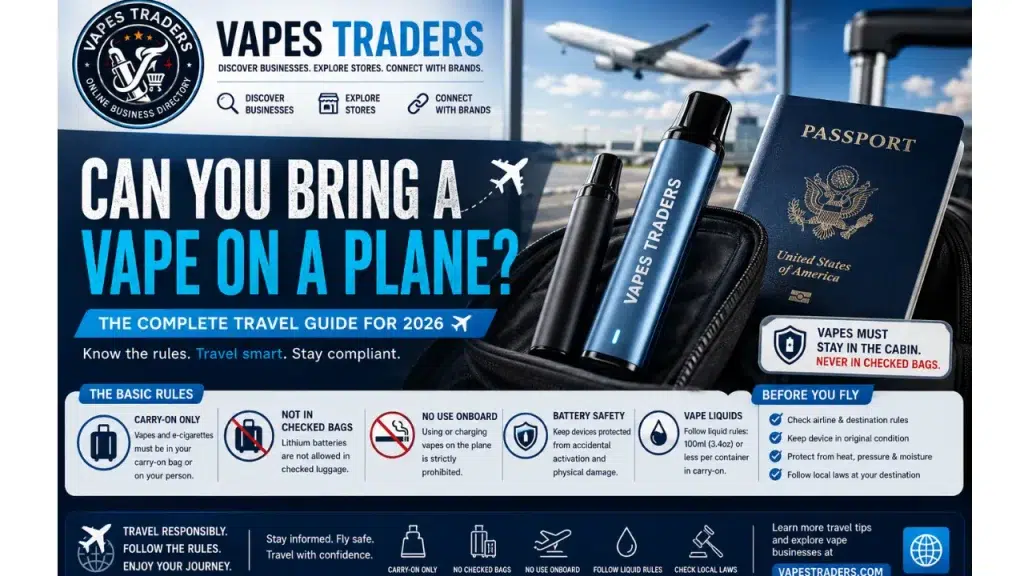
Yes, you can bring a vape on a plane in the United States, but it must stay in your carry-on bag or with you in the aircraft cabin. The Federal Aviation Administration (FAA) prohibits vaping devices in checked baggage because their lithium batteries can overheat or catch fire.
Disposable vapes, rechargeable vape pens, and electronic cigarettes follow the same basic safety rules. You also cannot use or charge these devices during a flight.
Here is what the FAA and Transportation Security Administration (TSA) require when traveling with vaping devices, e-liquids, and spare batteries.
TSA and FAA Rules for Bringing Vapes on a Plane
The TSA handles airport security screening, while the FAA establishes aviation safety requirements for battery-powered devices.
Under U.S. regulations, the following rules apply:
| Item | Carry-On Bag | Checked Bag |
| Disposable vape | Allowed* | Not allowed |
| Rechargeable vape | Allowed* | Not allowed |
| Vape pen or e-cigarette | Allowed* | Not allowed |
| Spare lithium batteries | Allowed with protection | Not allowed |
| Vape juice | Subject to TSA liquid limits | Generally allowed, subject to other restrictions |
Devices must meet battery safety requirements and any applicable airline restrictions.
The FAA requires passengers to prevent vaping devices from activating accidentally. A protective case, device lock, or another effective safety measure can help meet this requirement.
Official guidance: FAA Electronic Cigarettes and Vaping Devices.
Can You Bring a Vape in Your Carry-On Bag?
You can carry a permitted vape in your hand luggage or on your person. This applies to disposable devices, rechargeable vape pens, and other electronic smoking devices.
Keep the device protected against physical damage and accidental activation. If your vape has a power switch or locking feature, use it according to the manufacturer’s instructions.
Important: If airline staff ask you to check your carry-on bag at the boarding gate, remove your vape and any spare lithium batteries before handing over the bag. These items must remain in the passenger cabin.
Can You Put a Vape in a Checked Bag?
No. A vape cannot go in checked luggage, even when it is switched off or its battery is fully discharged.
Lithium batteries can develop dangerous heat if damaged, crushed, or short-circuited. Keeping electronic smoking devices in the cabin allows the crew to respond more quickly if a battery overheats.
This restriction also applies to disposable vapes with built-in batteries that cannot be removed.
If you discover a vape in your checked suitcase before departure, notify airline staff so the item can be handled according to airport procedures.
Can You Bring a Disposable Vape on a Plane?
Disposable vapes are allowed in carry-on baggage under U.S. rules when they meet the applicable safety requirements.
Unlike some rechargeable devices, disposable models often have enclosed batteries and no manual power switch. That makes protection against accidental activation especially important.
Keep the device in a suitable protective case and avoid carrying one that is leaking, swollen, damaged, or overheating. Do not open or modify a disposable vape to prepare it for travel.
A device that is not designed for recharging should never be connected to a charger.
How Much Vape Juice Can You Bring on a Plane?
E-liquid is treated differently from a battery-powered vape device.
Under the TSA’s standard 3-1-1 liquids rule, vape juice carried through U.S. airport security must meet these requirements:
- Each container must be 3.4 ounces (100 mL) or smaller.
- All standard carry-on liquids must fit into one clear, quart-sized bag.
- Each passenger is generally limited to one liquids bag.
A partially filled bottle larger than 100 mL does not meet the standard container-size rule.
Larger bottles of e-liquid may generally travel in checked baggage, provided the contents comply with applicable hazardous-materials rules, airline restrictions, and destination laws. This exception applies to the liquid, not the vaping device or its battery.
Secure bottle caps and use leak-resistant packaging to protect other items in your luggage.
How Many Vapes Can You Take on a Plane?
The FAA does not establish one universal number of vaping devices that every passenger can carry.
Airlines may set their own quantity limits for personal-use electronic smoking devices. If you are traveling with several vapes, check your airline’s policy before departure.
Battery size is another consideration. Under the FAA’s vaping-device requirements, individual lithium-ion batteries must not exceed 100 watt-hours (Wh), while lithium-metal batteries must not contain more than 2 grams of lithium.
Spare lithium batteries must remain in the cabin, with their terminals protected against short circuits. Individual battery cases, original retail packaging, or properly insulated terminals can provide protection.
Damaged, defective, or recalled batteries that present a risk of overheating or fire must not be brought aboard.
Can You Use or Charge a Vape on an Airplane?
No. Vaping is prohibited on commercial flights covered by U.S. Department of Transportation rules, including inside aircraft bathrooms.
You cannot use your vape even if it produces very little visible aerosol.
The FAA also prohibits charging electronic smoking devices and their batteries onboard. This includes charging through seat USB ports or other aircraft power outlets.
These restrictions apply throughout the flight, regardless of whether the device is disposable or rechargeable.
Can You Take a Vape on an International Flight?
International travel requires checking more than airline baggage rules.
A vaping device may meet aviation safety requirements but still be restricted or prohibited under the laws of your destination.
Some countries have restrictions covering the possession, importation, sale, or use of vaping products. Rules may also differ for nicotine-containing and nicotine-free products.
Before flying internationally, confirm the requirements of your airline, destination country, and any country where you will pass through customs during a connecting journey.
Do not assume that a vape permitted through U.S. airport security can legally enter another country.
What Happens If TSA Finds a Vape in Your Bag?
Finding a vaping device during airport screening does not automatically mean it will be confiscated.
If the device complies with applicable carry-on requirements, it can generally pass through U.S. airport security. However, TSA officers may inspect an item further and make the final screening decision.
A prohibited, unsafe, or noncompliant item may need to be removed or handled according to airport procedures.
The FAA’s checked-baggage prohibition remains in effect even if a device has already passed a security checkpoint.
FAQs
Can I bring a vape on a plane if I am under 21?
U.S. federal law prohibits retailers from selling tobacco products, including electronic cigarettes, to people under 21. This sales restriction is separate from TSA and FAA baggage rules. State laws, airline policies, and destination regulations may impose additional requirements.
Do I have to take my vape out of my bag at TSA security?
Not necessarily. Follow the instructions at your particular security checkpoint. TSA officers may ask you to remove electronic devices or other items for additional screening.
Can I bring a nicotine-free vape on a plane?
Yes, a permitted nicotine-free vaping device generally follows the same battery safety rules as a nicotine-containing vape. Its battery and heating element still create the same aviation safety considerations.
Final Thoughts
You can bring a vape on a plane under U.S. aviation rules, provided the device meets the applicable safety requirements and stays in the cabin.
Keep vaping devices out of checked baggage, protect their batteries, and never use or charge them during a flight. E-liquids must follow the applicable baggage and security screening rules.
For international trips, check local import and possession laws as well as airline requirements before departure.