
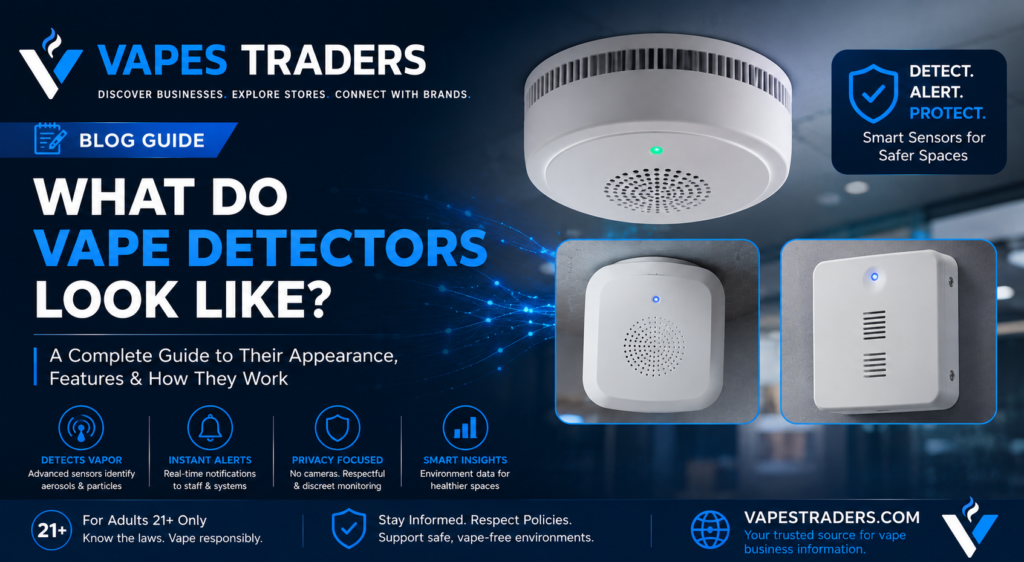
Have you ever noticed a small device attached to a ceiling or wall and wondered what it does? It might be a smoke detector, an air-quality monitor, or a specialized vape detector.
As schools, hotels, offices, and other facilities pay more attention to indoor air quality, vape detection technology has become an increasingly discussed topic. This raises a common question: What do vape detectors look like?
Most vape detectors have a compact design and resemble ordinary smoke alarms or environmental sensors. However, their appearance can vary depending on the manufacturer, technology, and installation location.
In this guide, we explain what vape detectors generally look like, their common features, where they are used, and how they differ from traditional smoke detectors.
What Does a Vape Detector Look Like?
A vape detector is usually a small electronic device installed on a ceiling or high on a wall. Many models have a simple, low-profile design that fits into indoor environments without looking out of place.
Common visual characteristics include:
- Compact housing: Often circular, square, or rectangular.
- Neutral colors: White, gray, or other colors that match ceilings and walls.
- Air openings: Small vents, holes, or perforated sections.
- Indicator lights: Some models have small LED lights showing device status.
- Fixed installation: Many devices are attached to ceilings or walls.
Not every vape detector has all these features. Some look similar to smoke alarms, while others resemble modern air-quality monitoring equipment.
What Are the Different Types of Vape Detectors?
Vape detection equipment is not made in just one design. Different facilities may use different types of sensors depending on their monitoring requirements.
A. Round Ceiling-Mounted Detectors
Some models have a circular shape similar to a conventional smoke detector. They are commonly designed for fixed indoor installation and may have openings that allow surrounding air to reach the sensing components.
B. Square or Rectangular Sensors
Other devices have a square or rectangular housing with rounded edges. Their appearance may be closer to a building security sensor or an indoor environmental monitor.
C. Air-Quality Monitoring Devices
Some advanced systems combine vape detection with other environmental measurements. Depending on the model, they may monitor air-quality indicators, temperature, humidity, or other conditions.
These devices are useful for facilities that want more than one type of environmental information from a single system.
3. Where Are Vape Detectors Commonly Installed?
Vape detectors are generally used in indoor areas where vaping is prohibited and facility managers want to monitor environmental conditions.
Common settings include:
Schools and educational buildings: Some schools install detection equipment in selected indoor areas as part of their campus policies.
Restrooms and locker rooms: These spaces may use dedicated sensors to monitor conditions while avoiding the need for video cameras in privacy-sensitive areas.
Hotels: Some hotels use environmental monitoring devices in designated areas to support their indoor smoking and vaping policies.
Offices: Workplace facilities may use sensors as part of broader indoor air-quality or building-management systems.
Other public buildings: Certain facilities may use specialized sensors in shared indoor spaces.
Installation practices vary by building, device, and local policy.
How Do Vape Detectors Work?
Vape detectors use electronic sensors to identify environmental conditions associated with vaping.
When someone uses an e-cigarette, the device releases an aerosol into the surrounding air. Specialized detection systems can monitor certain characteristics of that aerosol and identify patterns associated with vaping.
Depending on the model, a detector may use:
- Particle sensing technology
- Air-quality sensors
- Chemical or gas-sensing components
- Environmental monitoring features
- Sound-level monitoring in certain systems
When a system identifies a condition that meets its configured detection criteria, it may send an alert to authorized staff through a connected monitoring platform.
Not all detectors use the same technology, and their capabilities depend on the specific model.
What is the Difference Between a Vape Detector and a Smoke Detector?
Although vape detectors and smoke alarms can look similar, they are designed for different purposes.
| Feature | Vape detector | Traditional smoke detector |
|---|---|---|
| Main purpose | Identify conditions associated with vaping | Detect smoke associated with fire |
| Appearance | Round, square, or rectangular | Commonly round |
| Installation | Ceiling or wall | Ceiling or wall |
| Technology | Varies by model; may include particle or air-quality sensing | Commonly uses photoelectric or ionization sensing |
| Alerts | May send notifications to a monitoring system | Often activates an audible fire alarm |
| Main application | Indoor vaping and environmental monitoring | Fire safety |
A visual inspection alone cannot reliably identify the function of a device. Always check its manufacturer information or model specifications when identification is important.
Do Vape Detectors Have Cameras or Record Conversations?
This is a common question, especially when detection devices are installed in schools, restrooms, or changing areas.
Most dedicated vape detectors are designed around environmental sensing rather than video recording. A camera is not necessary for a device to detect vaping-related air conditions.
However, features vary between products. Some monitoring systems may include sound-level or other additional sensors, while others focus exclusively on environmental measurements.
It is important to review the manufacturer’s specifications and the facility’s privacy policy rather than assuming every device has the same capabilities.
Can Vape Detectors Give False Alerts?
Yes, like other environmental monitoring equipment, vape detectors are not necessarily perfect.
Their performance can depend on sensor technology, installation conditions, configuration, and the surrounding environment. Certain airborne particles, aerosols, cleaning products, or environmental changes may affect readings on some systems.
For this reason, a detection alert should be interpreted according to the device’s specifications and the facility’s procedures. An alert should not automatically be treated as proof that a particular person was vaping.
Are Vape Detectors Used in Schools?
Some schools and educational facilities use vape detection systems as one part of their approach to managing indoor vaping. These devices may help staff identify environmental events in selected areas and support the enforcement of school policies.
However, detection equipment is not a complete solution to youth vaping. Education, prevention, supportive conversations, and access to appropriate cessation resources are also important.
The goal should be to protect students’ health and maintain a safe learning environment.
Frequently Asked Questions
What do vape detectors look like?
Vape detectors commonly look like compact smoke alarms, air-quality sensors, or small security devices. They may have round, square, or rectangular housings with ventilation openings and sometimes indicator lights.
What do vape detectors look like in school bathrooms?
They are often fixed indoor sensors with compact housings. Depending on the model, they may resemble a traditional smoke detector or a small environmental monitoring device.
Are vape detectors round or square?
They can be either. Some manufacturers produce circular models, while others offer square or rectangular designs.
Do vape detectors have cameras?
Most dedicated environmental vape detectors do not require cameras. They identify certain environmental conditions using sensors. Additional features vary by manufacturer.
Do vape detectors make a loud alarm?
Not necessarily. Some systems send electronic notifications to authorized staff rather than sounding a traditional fire alarm. Alert methods depend on the product and its configuration.
Can a vape detector detect every type of vape?
Detection capabilities vary by device. Performance depends on the technology, the environment, and the manufacturer’s specifications. No single detector should be assumed to identify every vaping event under all conditions.
Are vape detectors the same as smoke alarms?
No. A traditional smoke alarm is designed primarily for fire safety, while a vape detector is designed to identify environmental conditions associated with vaping. Some devices may have overlapping sensing capabilities, but their purposes are different.
Can a vape detector identify the person who used a vape?
An environmental sensor generally detects conditions in an area rather than identifying a person’s identity. Any additional identification or monitoring features depend on the wider system and the facility’s policies.
Conclusion:
So, what do vape detectors look like? Most are compact electronic devices that resemble smoke alarms, air-quality monitors, or small security sensors. They may be round, square, or rectangular and are commonly installed on ceilings or walls.
Their appearance and capabilities vary by manufacturer, so there is no single design that represents every vape detector.
Understanding these devices helps people learn more about modern indoor monitoring technology, building policies, and environmental awareness.
At Vapes Traders, we aim to make information about vape-related businesses, products, and industry developments easier to explore. Our platform helps visitors discover business information and participating retailers; it does not operate as a vape retailer or certify the performance of detection equipment.
Disclaimer: This article is for general educational purposes only. Detection capabilities and privacy features vary by product. Consult the manufacturer’s documentation for accurate technical information.